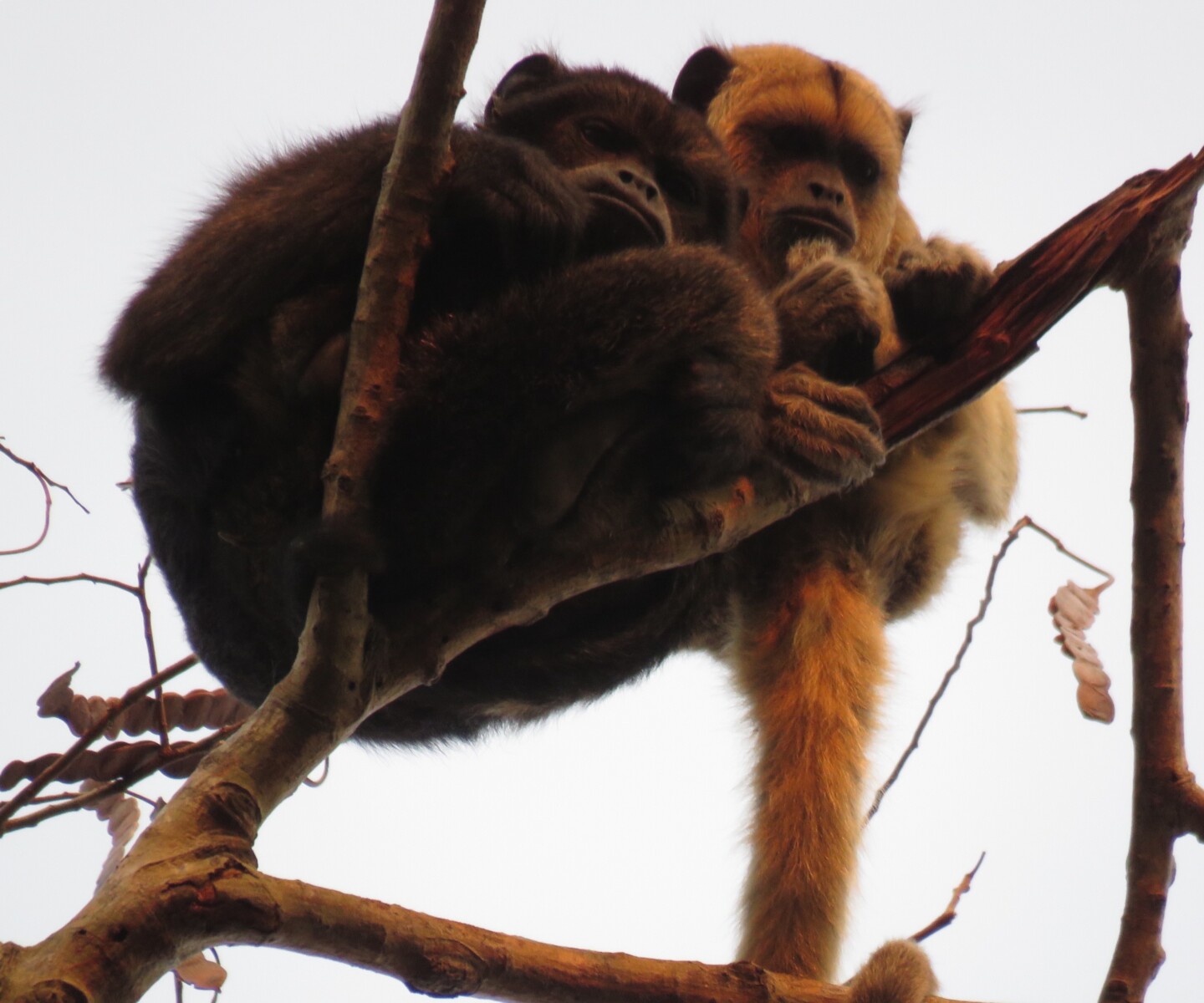
The Black Howler Monkey (Alouatta caraya) is a striking primate known for its powerful howling calls that can travel up to three miles through dense forest, making it one of the loudest animals in the world. Native to the forests of South America, primarily in Brazil, Paraguay, and Argentina, these monkeys exhibit significant sexual dimorphism: males are typically black, while females and juveniles tend toward shades of blonde or brown. Outfitted with a prehensile tail often as long as their body, which can reach up to 2.9 feet, these howlers navigate the treetops with an effortless grace. Their robust build, complete with prominent jaws and a specialized vocal apparatus, facilitates their iconic howls, which serve to establish territory and communicate with other groups. Living in social groups that can range from a handful to over a dozen individuals, Black Howler Monkeys are predominantly leaf-eaters, supplementing their diet with fruits and flowers. These fascinating creatures not only captivate with their eerie, resonant calls but also play a crucial role in their ecosystems by aiding seed dispersal.
Habitats & Distribution
The Black Howler Monkey primarily inhabits subtropical and tropical rainforests, often found in both primary and secondary forests. They thrive in dense forest canopies, utilizing their robust limbs and prehensile tails to navigate through the trees. Additionally, they can be found in gallery forests along rivers and edges of forests, demonstrating a certain degree of adaptability to different forest types.
Geographically, they are distributed across parts of South America, specifically in countries like Brazil, Paraguay, Bolivia, and northern Argentina. Their range typically includes the Pantanal, Chaco, and Atlantic Forest regions, where they can exploit a variety of food sources such as leaves, fruits, and flowers. Despite their relatively broad range, habitat destruction poses a threat to their populations, making conservation efforts crucial.
Behaviours & Reproduction
Black Howler Monkeys exhibit a highly social behavior, living in groups typically composed of one dominant male, several females, and their offspring, although some groups may contain more males. Their vocalizations, particularly their distinctive howling, play a key role in maintaining group cohesion and defining territory. During the breeding season, which is not strictly defined as they can mate year-round, the dominant male has primary mating rights, though other males in the group may also mate with females depending on social dynamics and individual hierarchies.
Females exhibit a peculiar reproductive strategy known as "promiscuous mating," where they may mate with multiple males within the group. This helps to obscure paternity and reduces the risk of infanticide from rival males, as each male may believe he has sired the offspring. The gestation period for black howlers is approximately 6 months, resulting in a single infant, which the mother cares for intensively. The young are weaned at about one year of age, but they remain dependent on their mothers for guidance and protection until they reach around 2-3 years old, at which point they start to explore independence or integrate more fully into the group’s social structures.
Diet
The Black Howler Monkey (Alouatta caraya) primarily feeds on leaves, which make up about 50% of their diet, but they also consume fruits, flowers, and nuts. This dietary preference categorizes them as folivores and frugivores. They are known for their ability to consume mature leaves, which are tougher and less nutrient-dense compared to young leaves, due to their specialized, enlarged cecum and colon that help ferment and digest the fibrous plant material. Additionally, the monkeys exhibit geophagy, consuming soil to supplement their diet with essential minerals and to aid in the detoxification of secondary plant compounds. The seasonal availability of fruits and flowers influences their diet, leading to variation in their food intake throughout the year.
Colors
The Black Howler Monkey (Alouatta caraya) exhibits sexual dimorphism in its coloration. Adult males are typically entirely black, while females and juveniles range from blonde to light brown. This stark contrast aids in camouflage within their leafy, shadowed habitat, blending with the varying light and dark shades of the forest. Their pelage lacks distinctive markings, but the dense fur provides a uniform color that helps them hide efficiently in their arboreal environment.
Fun Facts
Black Howler Monkeys possess a remarkable vocal prowess; their howls can be heard up to 3 miles away, functioning as territorial calls to mark their presence. Unlike many primates, they enjoy a mostly sedentary lifestyle, spending much of their time lounging or sleeping in the canopy. Their prehensile tails serve as a fifth limb, aiding in their arboreal navigation and providing balance while maneuvering through trees. Intriguingly, their diet primarily consists of leaves, making them folivores, a rarity among monkeys. Furthermore, the color of their fur markedly differs between sexes—males sport a glossy black coat, while females and juveniles don a golden brown color.
Conservation Status & Efforts
The Black Howler Monkey (Alouatta caraya) is currently classified as Least Concern by the IUCN, although its population trends are decreasing. Primary threats to this species include habitat destruction due to agricultural expansion, logging, and infrastructure development. Additionally, they are sometimes hunted for bushmeat or captured for the pet trade, which further exacerbates their decline.
Conservation efforts for the Black Howler Monkey focus on habitat protection and restoration. Several protected areas have been established within its range to safeguard critical habitats. Conservation organizations are also involved in research, monitoring population health, and implementing community education programs to reduce human-wildlife conflict and promote sustainable land-use practices. Furthermore, some initiatives aim to reforest degraded landscapes to provide new habitats for these primates.




