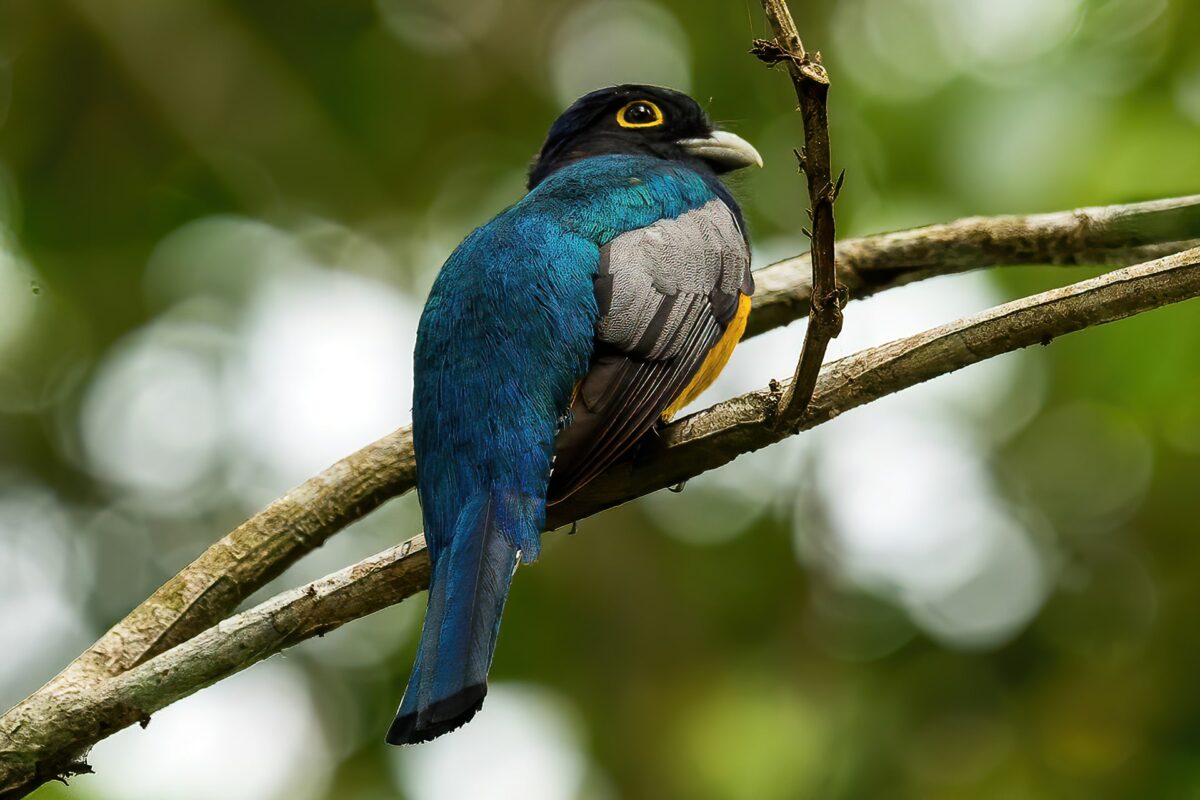
The Gartered Trogon (Trogon caligatus) is relatively small and compact yellow-bellied trogon of tropical lowland forest, mainly in humid areas. Perches at mid to upper levels, often high in canopy. Male has yellow eyering, female has broken white eyering; both sexes have narrow black-and-white barring on underside of tail. Female Gartered has white barring on its closed wings which female Black-headed Trogon lacks.
Habitats & Distribution
The Gartered Trogon thrives primarily in tropical and subtropical forests, favoring lowland and montane rainforests, secondary growth, and forest edges. These birds are often found in areas with dense canopy cover, where they can be seen perched quietly, hunting for insects and small fruits. They are also known to inhabit semi-open woodlands and plantations that provide adequate tree cover.
Geographically, the Gartered Trogon is distributed across a range that spans from southeastern Mexico, through Central America, reaching into northern Colombia and northwestern Ecuador. They are typically found at elevations ranging from sea level up to about 1,200 meters, though they can occasionally be seen at higher altitudes. The bird’s preference for lush, forested areas makes it a relatively common sight within its range, provided the habitat remains intact.
Behaviours & Reproduction
Gartered Trogons exhibit monogamous mating habits, typically forming pairs during the breeding season. These birds engage in elaborate courtship displays involving vocalizations and physical displays of their vibrant plumage to attract mates. The breeding season generally occurs from February to June, depending on their geographical location. Nesting usually takes place in abandoned woodpecker holes in dead trees or sometimes in termite mounds.
Within their loosely structured social system, Gartered Trogons are often solitary or found in pairs, showing territorial behavior primarily during the breeding season. Both parents share responsibilities in nesting and rearing their young, with females typically incubating the eggs while males assist in feeding the chicks once they hatch. This cooperative approach ensures better survival rates for the offspring.
Diet
Fruits, insects
Colors
Green, black, red
Fun Facts
Digs its nest in large arboreal wasp nests. Used to be known as Violaceous Trogon.
Conservation Status & Efforts
The Gartered Trogon (Trogon caligatus) is currently listed as Least Concern by the IUCN due to its wide range and presumably large population. Population trends appear to be stable, though specific population numbers are not well-documented. Habitat loss due to deforestation and land-use changes are the primary threats facing the species, particularly in Central America where agricultural expansion continues to reduce forest cover.
Conservation efforts for the Gartered Trogon focus mainly on habitat preservation. Protected areas and national parks within its range provide some refuge from habitat destruction. Additionally, promoting sustainable agricultural practices and reforestation projects aim to mitigate the adverse impact on their habitats. Birdwatching tourism in regions where the Gartered Trogon is found also helps raise awareness and funds for conservation initiatives.
Gallery






