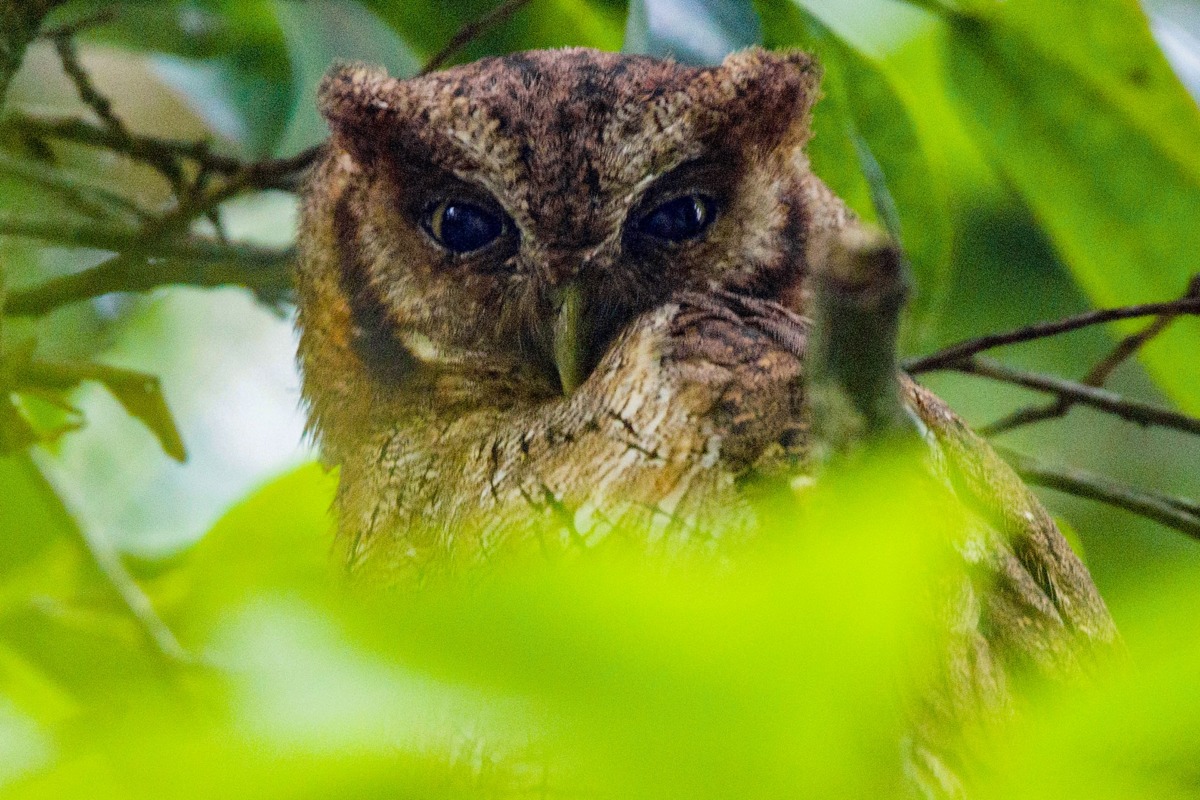
The Tropical Screech-Owl (Megascops choliba) is recognized by its round head and short tail, with grayish or brownish plumage. much easier to identify by voice: a short rapid trill with a pop at the end. If you’re lucky enough to see one, look for an overall grayish-brown or rufous bird with fine markings, including thin streaks on underparts. Black border to face. Sexes alike. Found in wooded habitats, sometimes coming out into open shrubby fields or gardens with only a few scattered trees. Usually the most common screech-owl in range.
Habitats & Distribution
The Tropical Screech-Owl inhabits a variety of environments, including tropical and subtropical forests, woodland edges, and even urban and rural areas with sufficient tree cover. This adaptability allows it to thrive in both dense, humid forests and more open areas with scattered trees. It typically roosts in tree cavities, dense foliage, or man-made structures, seeking shelter and suitable nesting sites. Geographically, the Tropical Screech-Owl's range extends from southern Texas and Mexico through Central America, reaching as far south as Bolivia, Paraguay, and northern Argentina in South America. It is commonly found at elevations from sea level up to 2,500 meters, with some local populations inhabiting higher altitudes. This broad distribution reflects its versatile habitat preferences and ability to coexist with human-modified landscapes.
Behaviours & Reproduction
Tropical Screech-Owls exhibit primarily monogamous mating habits, with pairs often remaining together for multiple breeding seasons. Their courtship involves a series of duets and calls to reinforce pair bonds. Nesting typically occurs in tree cavities or abandoned woodpecker holes, with little to no nest material added. The female lays 2 to 3 white eggs and incubates them for about 26-30 days while the male provides food. Both parents participate in feeding and caring for the chicks after hatching. These owls are generally solitary or found in pairs, and their nocturnal nature makes them elusive. They display a unique reproductive strategy known as asynchronous hatching, where eggs hatch over several days. This can result in a size hierarchy among chicks, which might increase survival chances for at least some offspring under adverse conditions.
Diet
Insects, small mammals, and birds
Colors
Grayish or brown with streaking
Fun Facts
Its call is often mistaken for a frog.
Conservation Status & Efforts
The Tropical Screech-Owl (Megascops choliba) is currently listed as Least Concern by the IUCN due to its wide distribution and stable population trends. This species is found throughout Central and South America in a variety of habitats, including forests, savannas, and urban areas. While not facing immediate large-scale threats, local populations can be impacted by habitat destruction due to deforestation and agricultural expansion. However, the species' adaptability to different environments, including disturbed landscapes, helps mitigate some of these pressures. Conservation efforts for the Tropical Screech-Owl primarily involve habitat protection and promoting sustainable land-use practices. National parks and natural reserves across its range provide crucial sanctuaries. Additionally, programs aimed at educating local communities about the ecological role of owls and the importance of biodiversity support the species indirectly by fostering environments conducive to their survival. Ongoing research and monitoring are essential to ensure that any emerging threats are promptly identified and addressed.
Gallery


