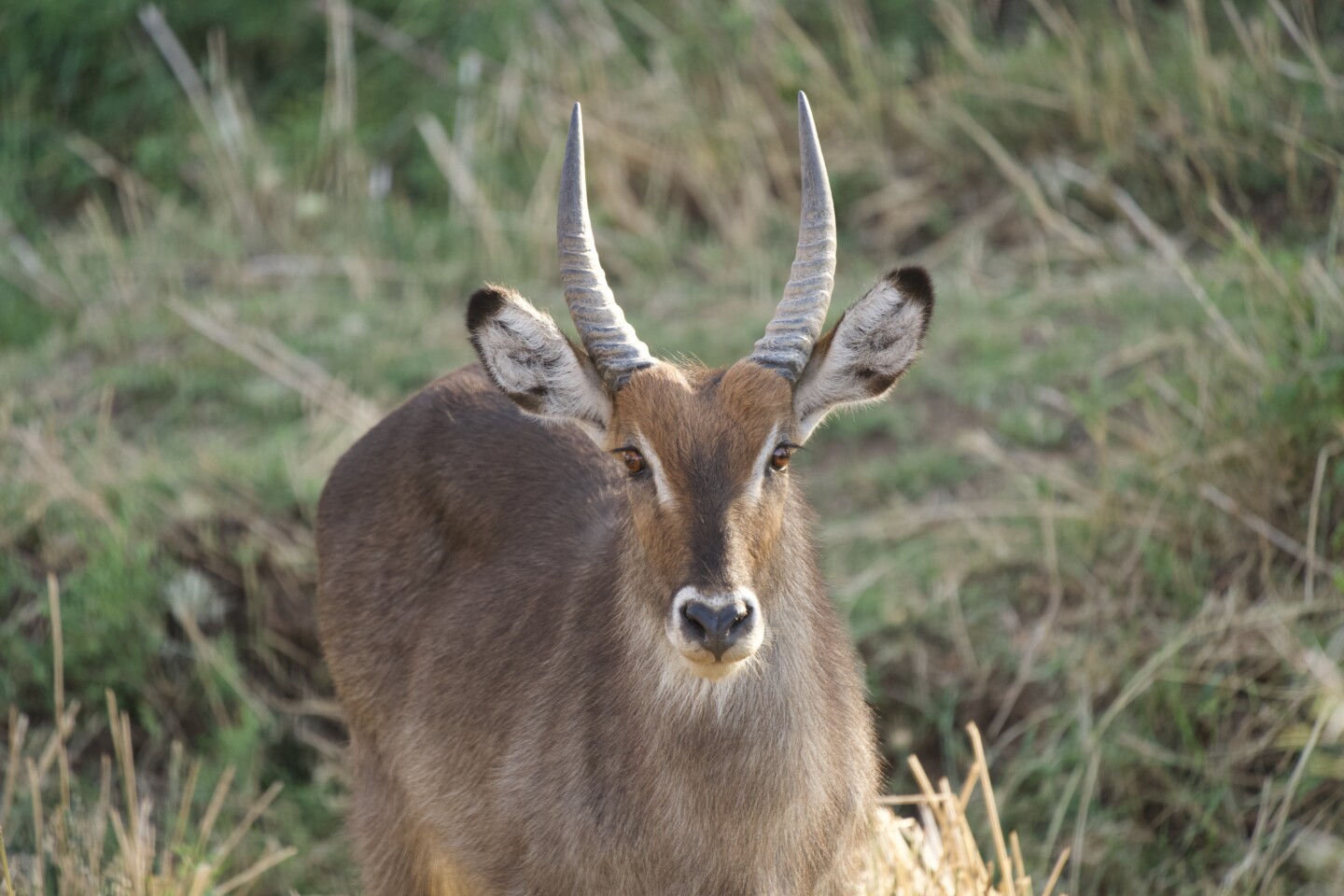
The Waterbuck (Kobus ellipsiprymnus) is a striking and robust African antelope known for its unique adaptation to water-rich habitats. Distinguished by a distinct white ring around its rump, often likened to a "toilet seat," this marking serves as a visual cue within its social structure. Standing up to 4.6 feet at the shoulder and weighing between 400 to 600 pounds, the Waterbuck displays a coarse, shaggy coat ranging from brown to grey, which secretes a waterproof oily secretion. This oily coat not only aids in repelling water but also emits a strong, musky odor, a natural defense against predators and parasites. Both sexes boast long, spiral horns, corrugated and backward-curving, which can reach impressive lengths of up to 40 inches. Preferring riverine forests, swamps, and savannas near water sources, Waterbucks are exceptional swimmers, often using water bodies to evade predators. Socially, they are found in small, loose-knit herds, exhibiting a territorial behavior. Overall, the Waterbuck's combination of unique physical traits and intriguing behaviors make it a fascinating subject of study and an iconic inhabitant of its natural environment.
Habitats & Distribution
Waterbucks are commonly found in sub-Saharan Africa, favoring regions near sources of water such as rivers, lakes, and swamps. Their preferred habitats include grasslands, savannas, and woodlands, which provide both the water and cover they need. These environments offer abundant fodder and protection from predators. Typically, waterbucks avoid dense forests and strictly arid areas, as their semi-aquatic nature necessitates proximity to water for drinking and cooling off, especially during the dry season. Furthermore, the geographical range of the waterbuck encompasses countries such as South Africa, Botswana, Kenya, Tanzania, and Uganda, where these suitable environments are widespread.
Behaviours & Reproduction
Waterbucks exhibit a polygynous mating system where dominant males defend territories that attract females. The social structure is typically characterized by small groups consisting of females and their offspring, while males often form bachelor herds or live solitarily until they establish a territory. Females choose mates based on territory quality, which ensures access to resources and protection. Reproduction is seasonal, with a peak during the rainy season, when food is abundant. Gestation lasts about eight months, resulting in the birth of a single calf. Calves are often hidden for the first few weeks of life to avoid predators, a behavior known as "lying-up," which increases their survival chances.
Diet
The waterbuck (Kobus ellipsiprymnus) primarily has a herbivorous diet that consists of grasses, which make up the majority of their food intake. They are known to favor green, short, and medium-length grasses that are nutrient-rich and often found in moist areas near water bodies. Interestingly, waterbucks are highly selective feeders and tend to graze on fresh, young shoots, avoiding older, fibrous grasses. They also occasionally consume leaves, herbs, and fruits to complement their diet. This selective grazing behavior helps them obtain optimal nutrition but can make them vulnerable to food scarcity during dry seasons when their preferred vegetation is less available. Waterbucks' reliance on water sources not only dictates their dietary patterns but also influences their habitat selection, as they are seldom found far from water.
Colors
The Waterbuck has a shaggy, reddish-brown to gray coat that becomes darker with age, featuring a distinct white "bib" on its throat. One of its most notable markings is a white ring encircling its rump, which acts as a follow-me signal for herd members. Their coloration and patterns provide effective camouflage in the tall grasses and wooded savannas they inhabit.
Fun Facts
Waterbucks possess some fascinating traits—they have a distinctive musky smell caused by a greasy substance secreted by their skin, which is thought to potentially make their coats waterproof. They are also known for their unique social behavior where males engage in ritualized displays instead of outright fighting to establish dominance. Interestingly, waterbucks are strong swimmers and frequently use water bodies as an escape route from predators like lions and hyenas. Lastly, their beautiful white elliptical-shaped ring found around their rump is not just for show—it serves as a following signal for herd members when they navigate through dense vegetation.
Conservation Status & Efforts
The conservation status of the waterbuck is currently listed as Least Concern according to the IUCN Red List. This designation reflects stable population trends in much of its range, although regional declines have been observed. The primary threats to the waterbuck include habitat destruction due to agricultural expansion, human-wildlife conflict, hunting, and competition with livestock. Poaching for bushmeat and hides also poses a significant threat in certain areas.
Conservation efforts for the waterbuck focus largely on habitat protection and management. Protected areas such as national parks and wildlife reserves play a crucial role in ensuring stable populations. Additionally, community-based conservation initiatives aim to involve local communities in sustainable wildlife management and conflict mitigation. Anti-poaching measures, along with legal protections and enforcement, help to curb illegal hunting. Conservation organizations are also working on ecological research to better understand waterbuck populations and habitat requirements, ensuring informed and effective conservation strategies.
Gallery