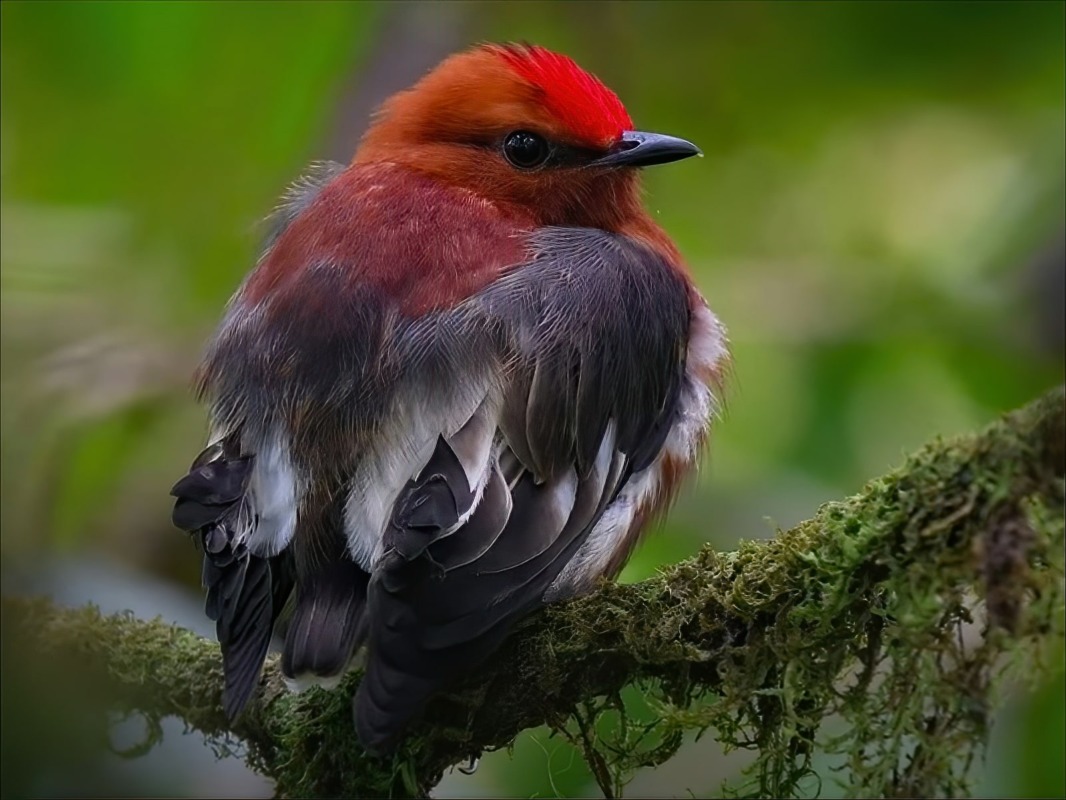
The Club-winged Manakin (Machaeropterus deliciosus) is the unique and entertaining manakin found in lush cloud forest in western Ecuador and western Colombia. Feeds on berries, usually at middle levels in the forest. Courtship display is unlike any other. Males hop and strut in neighboring trees at preferred display sites.
Habitats & Distribution
The Club-winged Manakin thrives primarily in humid, tropical lowland forests and foothill forests. It is typically found in areas with dense understory vegetation, which offers ample cover and feeding opportunities. These birds are closely associated with the Chocó and western Andean slopes where the environment provides the necessary conditions for their unique courtship displays. Geographically, the distribution of the Club-winged Manakin spans across the northwestern part of Ecuador and the southwestern part of Colombia. Its range is limited to regions with specific climatic and ecological conditions, thus making its habitat quite specialized and somewhat fragmented.
Behaviours & Reproduction
The Club-winged Manakin exhibits remarkable behavior during courtship, with males using their uniquely adapted wing feathers to produce intricate and high-pitched sounds. They perform elaborate display rituals involving wing-clicking and fluttering movements to attract females, often on designated perches known as leks. During these displays, males vie for the attention of females by showcasing their acoustic prowess and visual appeal, operating within a competitive yet non-territorial social structure. Reproduction is characterized by a polygynous mating system where a few dominant males get the majority of mating opportunities. Females select mates based on the males' display performance, and after mating, they are solely responsible for nest-building, egg incubation, and chick-rearing. No long-term bonds are formed between the sexes, and males typically continue to participate in competitive displays to attract additional mates. The unique stridulatory mechanism of sound production is a specialized trait seen in this species, underscoring the evolutionary pressures of sexual selection.
Diet
Fruits and insects
Colors
Wine-red, black, and white male is unlike any other species in range. Female is dull greenish-yellow and best identified by the orange or yellowish spot below her eye.
Fun Facts
They flick their wings upward, producing loud beeps by vibrating their feathers at incredibly high speeds.
Conservation Status & Efforts
The Club-winged Manakin (Machaeropterus deliciosus) currently holds a conservation status of "Least Concern" according to the IUCN Red List. Its population trend appears stable, although detailed long-term population monitoring is lacking. Primary threats to this species include habitat loss due to deforestation, driven by agriculture and logging activities. Fragmentation of its habitat in subtropical and tropical moist lowland forests also poses significant risks to its long-term viability. Conservation efforts for the Club-winged Manakin focus on habitat preservation and management. Protected areas within its geographical range, such as national parks and reserves, play a crucial role in safeguarding its habitat. Additionally, environmental organizations are working to promote sustainable land-use practices and reforestation projects to mitigate habitat destruction. Awareness and educational programs aimed at local communities further support conservation by fostering a culture of stewardship towards the species and its environment.




