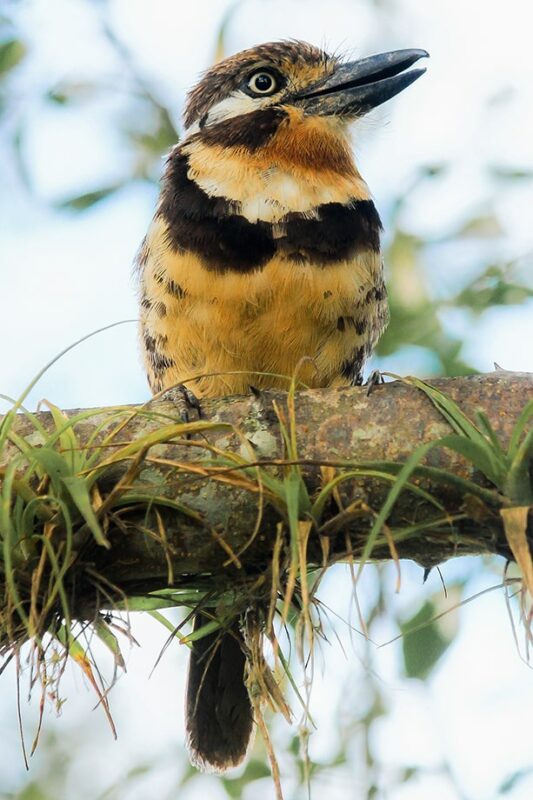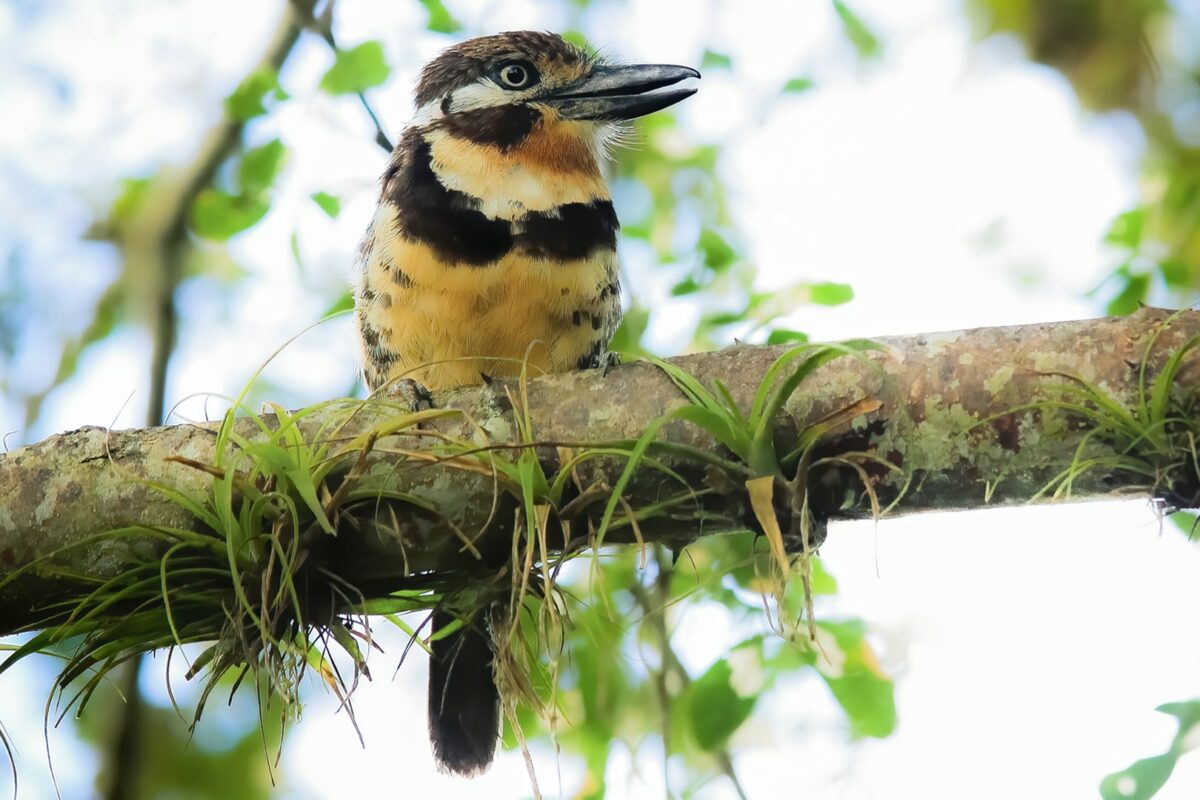
Chunky, stout billed, and often very conspicuous bird found mainly in dry and semi-humid forest north and west of the Andes. Note the ornate face pattern, buffy throat, and single black breast band. Pairs often perches in the open on exposed branches, wires, or fences, from which they sally out to snatch up a wide variety of prey. Song is a long series of whistles or clucks. Male and female often sing together in a noisy, chaotic duet.
Habitats & Distribution
The Russet-throated Puffbird inhabits a variety of lowland environments, primarily favoring dry forests, open woodlands, and scrubby areas. It can also be found in more humid forest edges and secondary growth, often near streams or other water sources. This preference for diverse habitats allows the puffbird to exploit a range of ecological niches, from dense canopy cover to more open, sunlit areas. Geographically, this species is distributed across northern South America, particularly in northern Colombia and northwestern Venezuela. In these regions, it is relatively common and can adapt to a variety of environmental conditions, contributing to its widespread presence. The bird is particularly well-suited to tropical and subtropical climates within its range, where it finds ample food sources and suitable nesting sites.
Behaviours & Reproduction
The Russet-throated Puffbird exhibits a relatively modest and unassuming social structure, often seen in pairs or small family groups. These monogamous birds engage in cooperative breeding, where offspring from previous broods may assist in caring for the next set of chicks. During courtship, males perform a series of calls and displays to attract females, often involving puffing their throats and showcasing their vibrant russet coloring. Reproduction typically takes place in cavities excavated in termitaries, trees, or earthen banks. Both parents share the responsibilities of incubating the eggs, which generally number between two to three per clutch, and feeding the chicks once they hatch. The altricial young are cared for intensively until they fledge, after which they may continue to rely on parental support for an extended period. This cooperative behavior enhances the survival rate of the offspring in their native habitats.
Diet
Its diet is mostly insects but also includes small vertebrates like lizards and some fruits.
Colors
The face is mainly white with a large yellow eye. The upperparts are brown with whitish spotting and white wing tips
Fun Facts
Similar to Two-banded Puffbird, which is found mostly east of the Andes, but never has more than one band.
Conservation Status & Efforts
The Russet-throated Puffbird (Hypnelus ruficollis) is currently classified as Least Concern by the IUCN. Its population is considered stable, and the species is relatively widespread within its range, which includes regions in Colombia and Venezuela. Although specific population numbers are not well-documented, there is no evidence of a rapid decline that would warrant a more threatened status. Primary threats to the Russet-throated Puffbird include habitat loss due to deforestation and agricultural expansion. Despite these pressures, the bird's adaptability to degraded habitats has somewhat mitigated the impact. Conservation efforts focus on habitat protection and environmental education to curb deforestation rates. Additionally, several protected areas within the bird's range offer some degree of habitat security, promoting long-term population stability.
Gallery