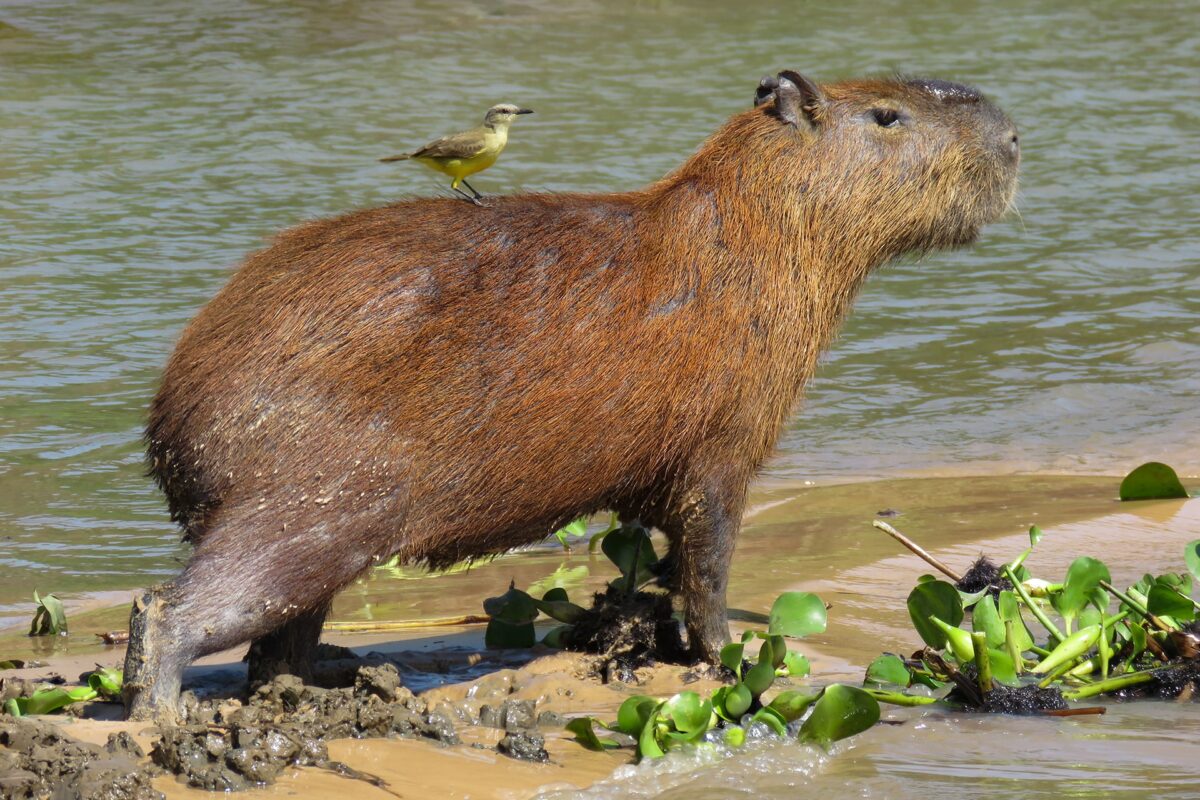
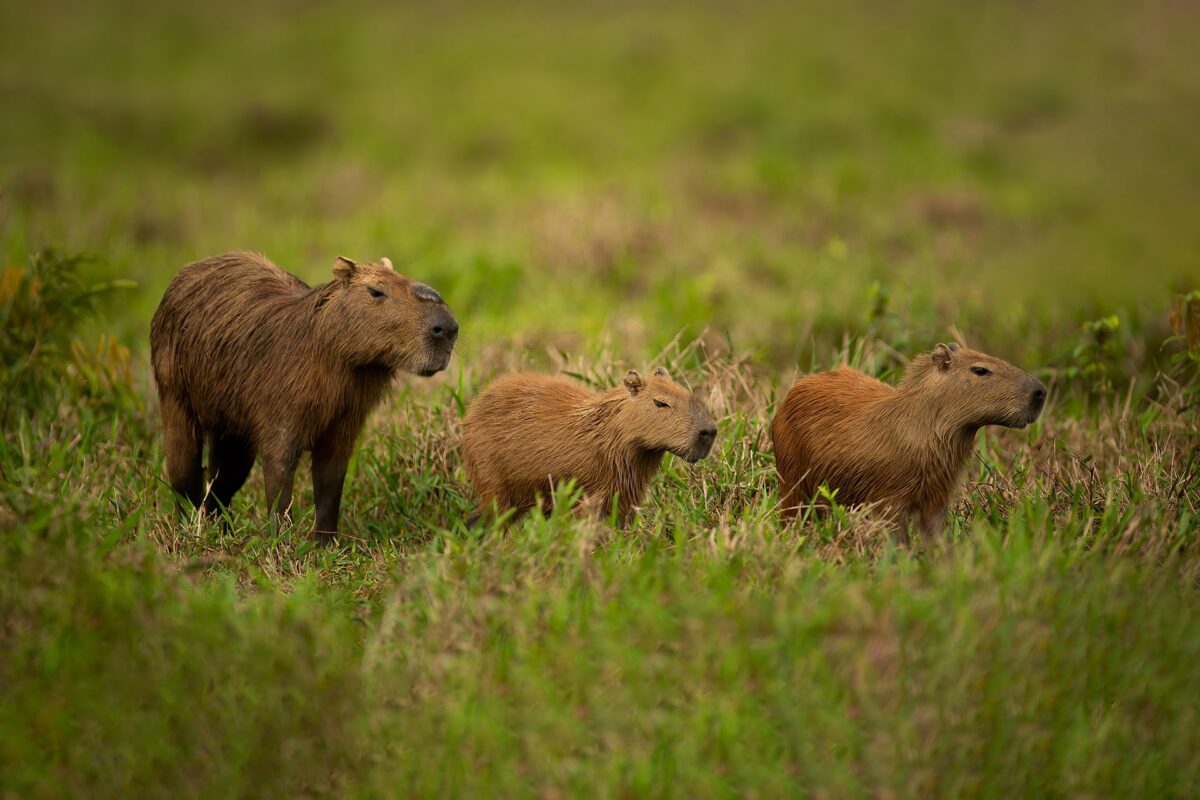
El capibara es el roedor más grande del mundo. Tiene un cuerpo robusto en forma de tonel, cabeza corta y nariz roma. Los carpinchos adultos pueden alcanzar una longitud de 106 a 134 centímetros, una altura de 50 a 62 centímetros a la altura del hombro y un peso de 35 a 66 kilogramos. Su pelaje es áspero y su color varía del marrón rojizo al grisáceo. Los carpinchos tienen las patas parcialmente palmeadas, lo que les ayuda a nadar, y los ojos, las orejas y los orificios nasales están situados en lo alto de la cabeza para mantenerse por encima del agua mientras nadan.
Hábitats y distribución
Capybaras predominantly reside in densely vegetated areas close to bodies of water, including rivers, lakes, swamps, and marshes. They thrive in a range of environments such as savannas, rainforests, and even floodplains, where they can readily access both land and aquatic vegetation for feeding. Their semi-aquatic nature makes these humid and water-abundant habitats ideal for their survival, providing both food resources and protection from predators. Geographically, capybaras are native to South America, with a distribution that spans from Panama in Central America down through Colombia, Venezuela, Brazil, Argentina, Uruguay, and Paraguay. They are especially prolific in the vast wetlands of Brazil’s Pantanal and Venezuela’s Llanos. Adaptability to a variety of water-related environments has facilitated their wide dispersal across these regions, making them one of the continent’s most recognizable and abundant rodent species.
Comportamiento y reproducción
Capybaras exhibit a highly social behavior, living in groups that can range from 10 to 20 individuals, although larger gatherings occur around water sources during the dry season. Dominance hierarchies within these groups are established through vocalizations, scent marking, and occasional physical altercations. Mating is polygynous, typically involving the dominant male, although females exercise some choice and may allow subdominant males to mate. Courtship involves the male following the female, emitting clicking sounds and sometimes engaging in mutual grooming. Reproduction in capybaras is unique for its flexibility; they breed throughout the year, with peaks during the rainy season. After a gestation period of about 150 days, females give birth to litters of 2-8 young, which are highly precocial and able to follow their mother shortly after birth. The communal nature of capybara groups means that young are often cared for by the entire group, providing them multiple mothers’ protection and increased survival rates.
Dieta
Herbívoro, se alimenta principalmente de hierbas y plantas acuáticas.
Colores
Rojizo, marrón, grisáceo
Datos curiosos
Capybaras are highly social animals, often found in groups of 10 to 20 individuals, but groups can number over 100 during the dry season.
They are excellent swimmers and can hold their breath underwater for up to five minutes.
Capybaras communicate through a variety of vocalizations, including purrs, whistles, barks, and clicks.
Despite their size, they can run as fast as a small horse.
Estado y esfuerzos de conservación
El carpincho, actualmente clasificado como "Preocupación Menor" por la UICN, muestra tendencias poblacionales estables en todas sus áreas de distribución nativas en Sudamérica. Sin embargo, amenazas localizadas como la destrucción de su hábitat, la caza por su carne y piel y la competencia con el ganado pueden afectar a sus poblaciones. La expansión urbana y el desarrollo agrícola han provocado la fragmentación de sus hábitats naturales, como humedales, riberas y bosques. Para contrarrestar estas amenazas, se están aplicando varias medidas de conservación. Las zonas protegidas y las reservas naturales ofrecen hábitats seguros, mientras que los programas de educación ambiental conciencian sobre la importancia de los capibaras en sus ecosistemas. Además, se promueven prácticas de gestión sostenible para regular la caza y garantizar que las poblaciones de capibaras se mantengan sanas y resistentes. Las organizaciones conservacionistas también trabajan con las comunidades locales para desarrollar iniciativas de ecoturismo que ofrezcan incentivos económicos para preservar los hábitats de los capibaras.
Galería