La diversité de la Colombie
Explorer la riche diversité de la flore, de la faune et de la culture colombiennes.

Imagine a country where you can travel from the highest snow-capped peaks, through lush rainforests, across open savannahs, and end up on stunning coastal beaches – all in one day! Colombia offers all this and more. In fact, Colombia, located at the crossroads of Central and South America, is one of the world’s biodiversity hotspots, rich in a diverse array of flora and fauna that leave nature lovers in awe.
Un voyage à travers la biodiversité colombienne
Now, are you ready to take a deep dive into the Colombian biodiversity that Mother Nature has so generously endowed? From the heights of the Andean peaks to the depths of the Pacific, from the endless plains of Orinoquía to the dense forests of the Amazon, the biodiversity of Colombia is a treasure trove waiting to be discovered. Let’s embark on this journey, shall we?
Comprendre la biodiversité
Before we embark on our adventure, let’s briefly explore the concept of biodiversity. It’s a term we’ve all heard, but what exactly does it mean?
Que signifie la biodiversité ?
Par essence, la biodiversité, ou diversité biologique, désigne la variété de la vie sur Terre. Elle s'étend des plus petits micro-organismes aux plus grandes baleines, des mauvaises herbes les plus communes aux orchidées les plus rares, et des déserts les plus arides aux forêts tropicales les plus luxuriantes. Vous êtes-vous déjà interrogé sur la diversité des formes de vie qui nous entourent ? C'est ce que l'on appelle la biodiversité.
Pourquoi la biodiversité est-elle importante ?
Now, you may wonder, why is biodiversity so important? First and foremost, biodiversity is crucial for the health of our planet. Different species and ecosystems play vital roles in natural processes like nutrient cycling, climate regulation, and pollination. Moreover, biodiversity is also vital for human survival and wellbeing. It provides us with food, medicine, raw materials, and also has cultural and recreational value. The wealth of biodiversity is indeed a treasure that we must strive to conserve. Are we ready now to delve into the rich biodiversity of Colombia?
Colombie : Une puissance en matière de biodiversité
Have you ever imagined how it would feel to be in a place that’s home to more than 10% of the world’s species? That’s Colombia for you! Ranked second in the world for biodiversity, Colombia boasts an astonishing array of life forms. According to The Nature Conservancy, Colombia is home to more than 1,900 species of birds, 20,000 species of plants, and 456 species of mammals, just to name a few!
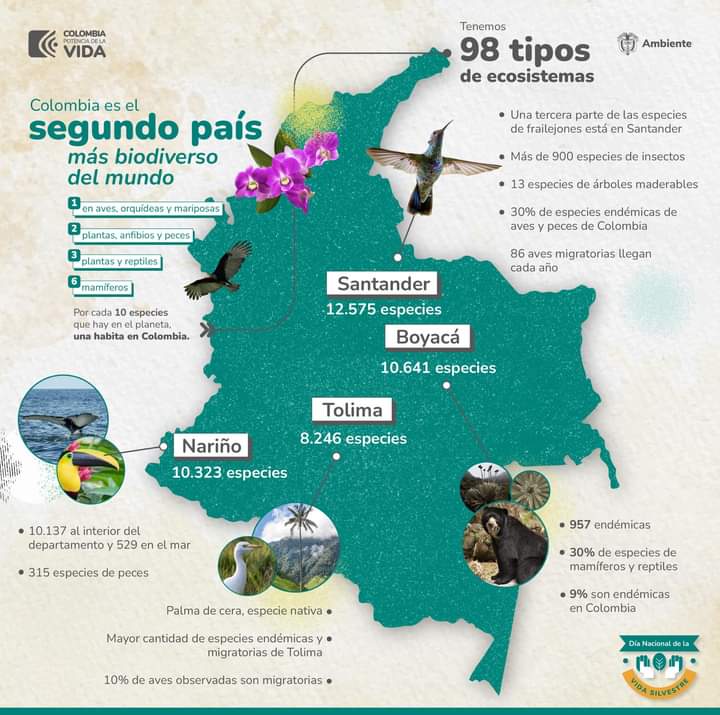
Colombia’s Ranking in Global Biodiversity
As per the data from the United Nations Development Programme, Colombia is one of the 17 megadiverse countries in the world. And it’s not just about the total number of species. Colombia also stands out for its incredibly high level of endemism – that is, species that are found nowhere else in the world. According to the UNDP, Colombia is the country with the highest number of endemic species of birds and orchids in the world. Now, isn’t that fascinating?
La magie géographique de la Colombie
You may wonder, why is Colombia such a biodiversity powerhouse? The answer lies in its unique geography. Colombia’s location near the equator, combined with its varied topography, gives it an incredibly diverse range of climates and habitats, from tropical rainforests and wetlands to deserts and alpine grasslands. What other countries can boast of such geographical variety within their borders?
Biomes de la Colombie
Colombia is divided into five main biomes, or ecological regions, each with its unique flora, fauna, and ecosystems. Let’s take a walk through these fascinating biomes and get a taste of their unique biodiversity.
La région andine
Welcome to the Andean region, where majestic peaks reach for the sky and the air is thin and crisp. This region is home to the famous Andean Condor, the national bird of Colombia, and the Spectacled Bear, the only bear species native to South America. You’ll also find unique plants like the frailejones, a group of high-altitude plants endemic to the Andes, which play a crucial role in water regulation.
La forêt amazonienne
Venture into the heart of the Amazon rainforest, and you’ll be greeted by a cacophony of sounds – the call of howler monkeys, the screech of macaws, the drone of insects, and the rush of water. The Colombian Amazon is home to the largest and most diverse tropical rainforest in the world, teeming with species like the Jaguar, Giant Anteater, Pink River Dolphin, and countless birds, insects, and plants. Can you picture the myriad hues of life in this forest?

Les côtes des Caraïbes et du Pacifique
Now, let’s take a detour to the coasts. Along the Caribbean and Pacific coasts, you’ll find a different kind of biodiversity, with coral reefs, mangrove forests, and sea turtle nesting beaches. This is the realm of creatures like the West Indian Manatee, the Scarlet Ibis, and the endangered Hawksbill Turtle. Do you feel the allure of the coastal ecosystems?
The Eastern Plains (Orinoquía)
Finally, let’s journey to the vast savannahs of the Orinoquía, where rivers meander through grasslands and wetlands, and the horizon seems endless. Here, you’ll find the Giant River Otter, the Orinoco Crocodile, and a fascinating variety of birds and fish. How does it feel to be in the open plains, far from the hustle and bustle of city life?
Colombia’s Unique Flora and Fauna
Now that we’ve journeyed through the different biomes, let’s take a closer look at some of the unique species that make Colombia’s biodiversity so special. You’d be surprised by the variety!
Les espèces emblématiques de la Colombie
Among the plethora of species in Colombia, some stand out for their beauty, rarity, or cultural significance. The Andean Condor, with its impressive wingspan and royal demeanour, is one such iconic species. The Colombian Weasel, the world’s smallest weasel and one of the rarest mammals, is another. And who can forget the Wax Palm, Colombia’s national tree, whose slender form towers over other trees in the Andean landscape?
L'espèce endémique : Seulement en Colombie !
Did you know that Colombia is home to over 300 species of birds that you won’t find anywhere else in the world? One of these is the Beautiful Woodpecker, aptly named for its vibrant red and black plumage. The Colombian Slider, a freshwater turtle found only in the Magdalena River Basin, is another example. Imagine having such unique creatures in your backyard!
Efforts de conservation en Colombie
With such a wealth of biodiversity comes the responsibility of conservation. Let’s take a look at some of the initiatives that are being taken to conserve Colombia’s natural heritage.
Initiatives gouvernementales
The Colombian government has designated a significant portion of the country’s land and marine areas as protected areas, including national parks, nature reserves, and sanctuaries. These areas serve as crucial habitats for a multitude of species and play a key role in biodiversity conservation.
Les organisations non gouvernementales et leur travail
Numerous non-governmental organizations are also working tirelessly to conserve Colombia’s biodiversity. These include international organizations like the World Wildlife Fund and Conservation International, as well as local organizations like Fundación Omacha and ProAves. Their work spans a wide range of activities, from habitat conservation and species protection to environmental education and community engagement.
Conservation pilotée par la communauté
Les initiatives de conservation menées par les communautés se sont avérées extrêmement efficaces en Colombie. Les communautés indigènes, en particulier, ont été à l'avant-garde de ces initiatives, utilisant leurs connaissances et pratiques traditionnelles pour conserver leurs écosystèmes locaux. Cette forme de conservation ne vise pas seulement à protéger la biodiversité, mais aussi à renforcer les capacités des communautés locales et à reconnaître leurs droits et leurs connaissances.
The Joy of Experiencing Colombia’s Biodiversity
For nature lovers and travelers, Colombia offers endless opportunities to experience its rich biodiversity. However, as visitors, we must remember to do so responsibly, to ensure that our presence does not harm the very beauty we’ve come to admire.
Les meilleures régions pour le tourisme lié à la biodiversité
Whether you’re a bird watcher, a botany enthusiast, a wildlife photographer, or simply a nature lover, Colombia has something for you. The Andean region, with its high-altitude ecosystems and unique species, is a must-visit for bird watchers. The Amazon, with its vast rainforest and rich indigenous cultures, offers an immersive experience like no other. The coasts offer opportunities for snorkeling, diving, and marine wildlife watching. The key is to choose responsibly managed eco-tourism destinations that prioritize conservation and community involvement.
Tourisme responsable : comment visiter sans nuire
How can you ensure that your visit doesn’t harm the local ecosystems? Here are a few tips: Follow all rules and guidelines when visiting natural areas. Avoid disturbing wildlife or damaging vegetation. Respect local cultures and traditions. And, of course, leave no trace – take only memories and leave only footprints. Remember, responsible tourism is not just about enjoying nature, but also about contributing to its conservation.
Colombia’s Biodiversity on a Map
Seeing Colombia’s biodiversity on a map gives us a new perspective on the extent and variety of life in this country. Let’s take a closer look!
Reading the Map: What’s Where?
On a biodiversity map of Colombia, you’ll see the different biomes colour-coded, with symbols representing different species or groups of species. You’ll notice the high concentration of species in areas like the Andean region and the Amazon, and the unique species in the coastal and Orinoquía regions. Isn’t it fascinating to see Colombia’s biodiversity represented in this way?
Explorer les régions à travers la carte
La carte nous permet de faire un voyage virtuel à travers les différentes régions de la Colombie, en découvrant la biodiversité unique de chacune d'entre elles. En traçant les lignes et les symboles sur la carte, nous nous rendons compte de l'immense richesse de la biodiversité que recèle la Colombie. Cette prise de conscience s'accompagne d'un sentiment renouvelé d'émerveillement et de responsabilité à l'égard du monde naturel.
Conclusion : Un monde dans un pays
As we come to the end of our journey through Colombia’s biodiversity, we are left with a sense of awe for the incredible variety of life that this country holds. Colombia’s biodiversity is indeed a world within a country, a treasure trove that we must strive to conserve and respect. So, the next time you think of biodiversity, remember the colours, sounds, and shapes of Colombian nature. Remember that every species, no matter how small or commonplace, plays a crucial role in the tapestry of life. And most importantly, remember that it is up to us to ensure that this tapestry remains vibrant for generations to come. Will you join us in this mission?




