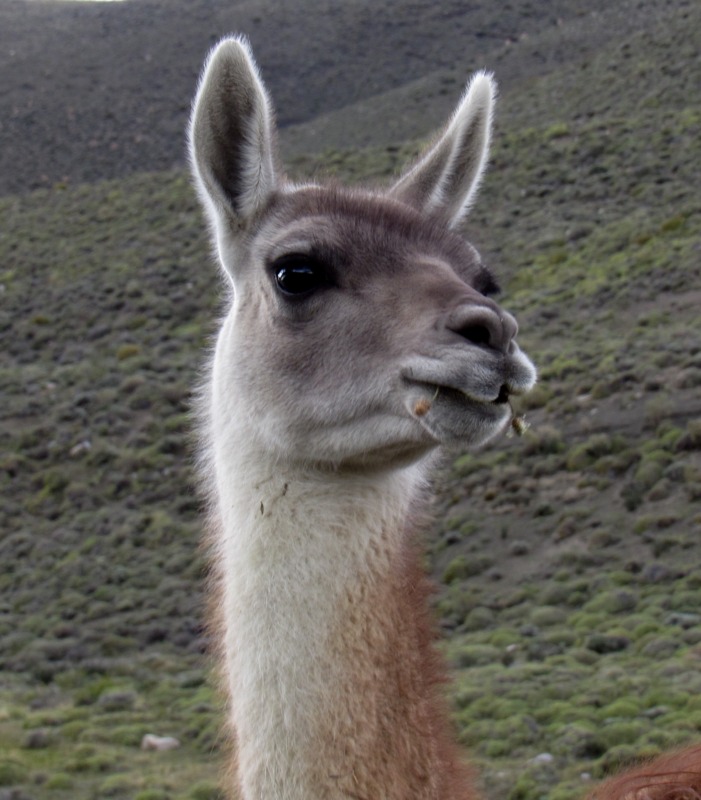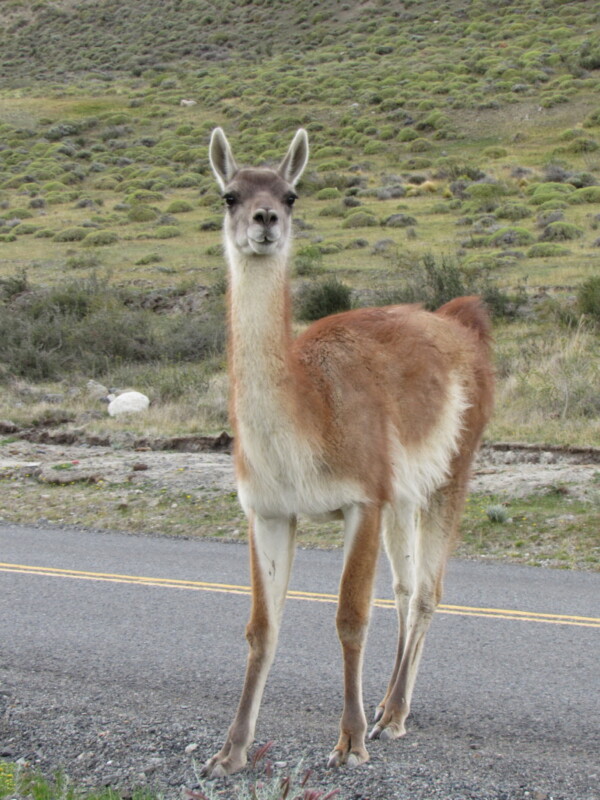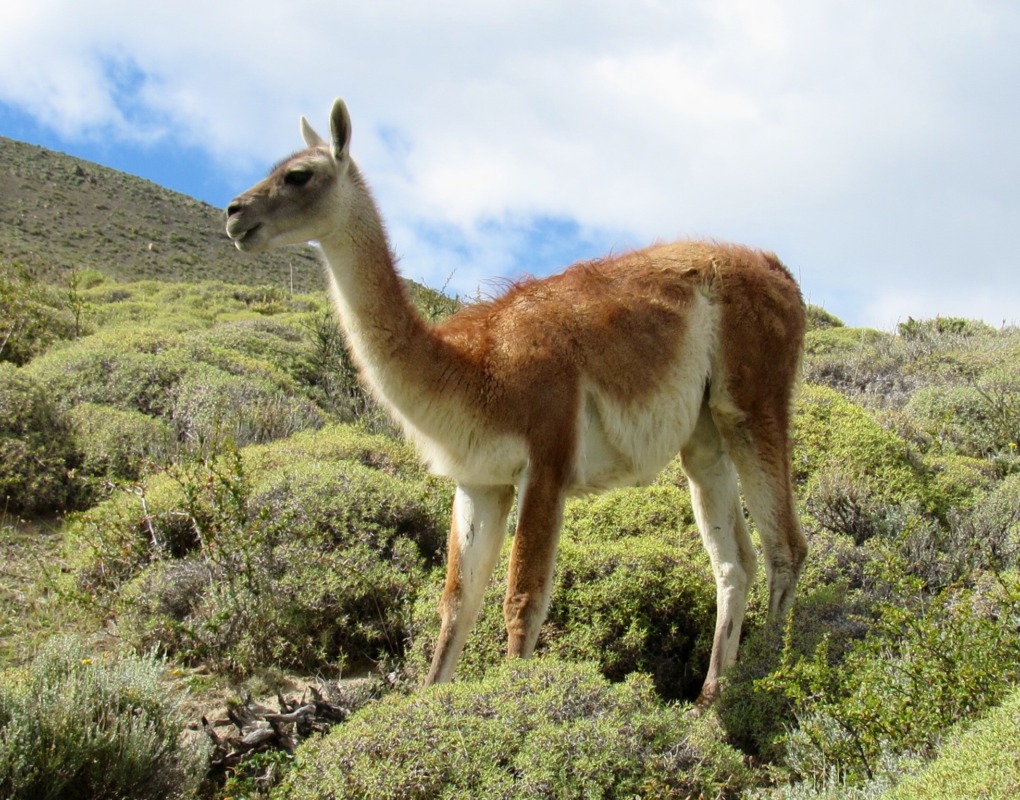
The Guanaco (Lama guanicoe) is a captivating and resilient native of the arid, windswept regions of South America, particularly thriving in the Patagonian steppes and the high altitudes of the Andes. These graceful camelids are distinguished by their slender, agile bodies, standing about 1.0 to 1.2 meters (3.3 to 3.9 feet) at the shoulder, with a rich, tawny-brown coat that contrasts strikingly with their paler undersides. Their expressive eyes, long necks, and pointed ears give them a vigilant yet serene demeanor. Guanacos are highly sociable, often forming small family groups or larger herds, exhibiting a remarkable adaptability to harsh environments. One of their notable features is their efficient way of thermoregulation, which allows them to endure extreme temperature fluctuations. As herbivores, they play a crucial role in their ecosystems, grazing on a variety of grasses and shrubs, which helps maintain the ecological balance. Their unique ability to thrive in some of the most inhospitable landscapes showcases their evolutionary success and enduring presence in South America's wildlife tapestry.
Habitats e distribuição
The guanaco inhabits a variety of environments across South America, ranging from the arid plains of the Patagonian steppes to the high-altitude regions of the Andes Mountains, reaching elevations up to 4,000 meters (13,000 feet). They are well-adapted to harsh conditions, thriving in areas with sparse vegetation, where they feed on grasses, shrubs, and lichens. Guanacos can also be found in more temperate zones, including coastal regions and open forests, thanks to their versatile diet and ability to endure extreme temperatures.
Geographically, their range extends from the southern parts of Peru and Bolivia, through Chile and Argentina, down to Tierra del Fuego. Historically widespread, guanaco populations have been reduced due to hunting and habitat loss, but they remain relatively abundant in national parks and protected areas. In addition to their mainland distribution, a small number of guanacos are present on the Falkland Islands.
Comportamentos e reprodução
Guanacos exhibit a polygynous mating system, where dominant males establish and defend territories that include access to a harem of females. These males engage in aggressive displays and physical confrontations to ward off rival males and maintain control over their group. Breeding season peaks during the austral summer, primarily from November to February. After a gestation period of about 11.5 months, females give birth to a single offspring, known as a chulengo, which is precocial and able to run shortly after birth.
Guanaco social structure consists of family groups, bachelor groups, and solitary males. Family groups are led by a single dominant male and include multiple females and their young. Bachelor groups are composed of younger males who have not yet acquired a territory or harem. These social structures facilitate the protection of young and the efficient use of available resources. The territorial behavior and structured social organization of guanacos contribute to their reproductive success in the challenging environments of South America.
Dieta
The Guanaco (Lama guanicoe) primarily consumes a diet of grasses, leaves, and shrubs, which they graze on in the arid and semi-arid regions of South America. They exhibit a preference for tender, green vegetation, but they are highly adaptable and can survive on sparse vegetation, making them well-suited to their often harsh habitats. Guanacos have a complex stomach with multiple chambers that allow them to efficiently digest tough plant material and extract maximum nutrients, similar to other camelids. Remarkably, they can survive without water for extended periods, deriving necessary moisture from the plants they consume. In times of scarcity, Guanacos are known to browse for food high up in the mountains or on coastal plains, showcasing their incredible resilience and adaptability in diverse environments.
Cores
The Guanaco (Lama guanicoe) has a distinctive coloration with a light brown to dark cinnamon fur on its back and sides, and a contrasting white underbelly, inner legs, and face. They typically have a grey face with a white fringe around the mouth and a dark nose, helping them blend into the open, arid landscapes and high-altitude plains they inhabit.
Factos divertidos
Guanacos are fascinating creatures known for their quirky behavior of spitting to settle disputes and establish dominance. These swift runners can reach speeds of up to 35 miles per hour, making them excellent at evading predators. Their wool, though not as domesticated as their llama relatives, is incredibly soft and highly valued. Notably, guanacos have a unique adaptation for high-altitude living; their blood has an unusually high concentration of red blood cells, allowing them to efficiently absorb oxygen in the low-oxygen environments of the Andes. They are also known for their vocalizations, which range from gentle hums to loud, alerting calls that can be heard over long distances.
Estado de conservação e esforços
The conservation status of the guanaco is currently classified as "Least Concern" by the IUCN, though certain regional populations are experiencing declines. Population trends show variability; while some areas report stable or increasing numbers, others, particularly in Argentina, face significant challenges. The primary threats to guanacos include habitat loss due to agricultural expansion, overgrazing by livestock, hunting, and competition for forage with domestic animals.
Conservation efforts focus on habitat protection, sustainable land management practices, and legal measures to curb poaching. Protected areas and national parks in countries like Chile and Argentina provide safe habitats for guanaco populations. Initiatives such as reforestation and controlled grazing are being implemented to improve habitat quality. Furthermore, community-based conservation programs are key, involving local residents in the protection and monitoring of guanaco populations to ensure long-term sustainability.
Galeria