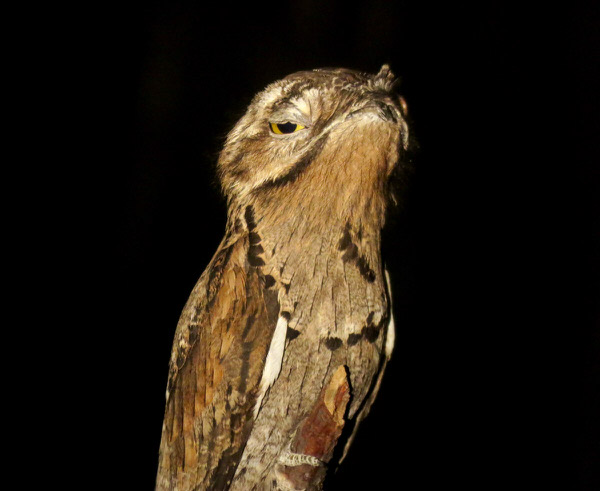
O potoo grande é uma espécie de noitibó encontrada nas florestas da América do Sul e Central. Tem uma plumagem críptica cinzenta, castanha e preta que lhes permite misturarem-se nos troncos das árvores onde se empoleiram. Tem grandes olhos amarelos e emite um som único e assombroso à noite. Capturam presas como insectos no ar.
Habitats e distribuição
The Great Potoo primarily inhabits tropical and subtropical forests, including both lowland and montane rainforests. It prefers areas with dense canopy cover which provide ample opportunities for camouflage during the day when it perches motionless on tree branches or stumps. These birds are often found in regions with abundant large trees and a variety of insects, their primary food source. Geographically, the Great Potoo is distributed across Central and South America. Its range extends from southern Mexico through Central America to northern South America, including countries like Colombia, Venezuela, Ecuador, Peru, and Brazil. Despite its wide distribution, it is more frequently sighted in less disturbed habitats, avoiding heavily urbanized or deforested areas.
Comportamentos e reprodução
The Great Potoo exhibits solitary behavior and is primarily nocturnal, roosting motionless during the day, using its cryptic plumage to blend seamlessly with tree branches. During mating season, these birds are monogamous, with pairs forming strong, long-term bonds. Courtship involves vocal duets and gentle bill snapping. Unlike many other birds, Great Potoos do not build elaborate nests; instead, they lay a single mottled egg directly on a flat, branchless tree stump or in a shallow tree cavity. Both parents share responsibilities, taking turns incubating the egg and, post-hatching, in feeding and caring for the chick until it fledges. This minimalistic nesting strategy, combined with their remarkable camouflage, helps protect them and their offspring from predators.
Dieta
Insectos e outros artrópodes
Cores
Plumagem críptica cinzenta, castanha e preta
Factos divertidos
Os patos-grandes são mestres da camuflagem! A sua plumagem e a sua capacidade de se manterem imóveis quando empoleirados fazem com que pareçam parte de uma árvore.
Estado de conservação e esforços
The Great Potoo (Nyctibius grandis) is currently classified as Least Concern by the IUCN, indicating that it is not facing immediate threats of extinction. Population trends for the Great Potoo are generally considered stable across its extensive range in Central and South America. However, localized declines can occur due to habitat destruction, primarily from deforestation and human encroachment, which result in the loss of its preferred nocturnal roosting and nesting sites. Conservation efforts for the Great Potoo focus predominantly on habitat preservation. Protected areas and national parks throughout its range offer crucial refuges that safeguard not only the Great Potoo but also a variety of other forest-dependent species. Additionally, community-based conservation programs and environmental education initiatives aim to mitigate human impact by promoting sustainable land use and fostering awareness about this enigmatic nocturnal bird. These measures collectively help maintain the stability of the Great Potoo populations in the wild.
Galeria





