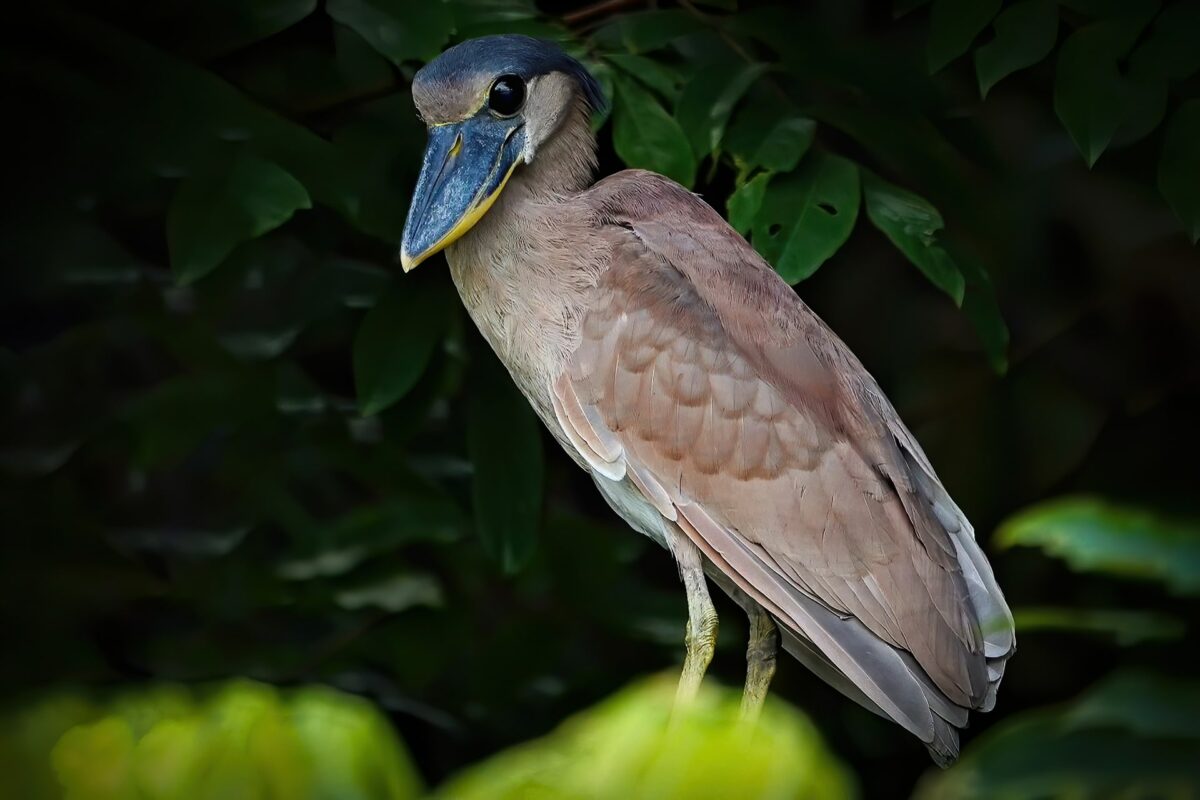
The boat-billed Heron (Cochlearius cochlearius), colloquially known as the boatbill, is an atypical member of the heron family, and was formerly placed in a monotypic family, the Cochleariidae. It lives in mangrove swamps from Mexico south to Peru and Brazil. It is a nocturnal bird, and breeds semicolonially in mangrove trees, laying two to four bluish-white eggs in a twig nest. Bizarre nocturnal heron of mangroves and freshwater marshes in tropical lowlands; spends the daytime roosting in trees, often in loose groups. Comes out at night to feed along the edge of lakes and rivers. Easily identified by huge ‘boat bill’ and big brown eyes. Adult has black crown, pinkish breast, and silvery gray back; immature pattern similar, but plumage duller and browner overall.
Habitats & Distribution
The Boat-billed Heron primarily inhabits mangrove swamps, estuaries, and freshwater wetlands. It prefers areas with dense vegetation and slow-moving water, where it can find ample shelter and food. This nocturnal bird is adept at navigating through thick mangrove roots and other submerged vegetation as it hunts for fish, crustaceans, and insects. Geographically, the Boat-billed Heron is found in a wide range extending from Mexico through Central America and into the northern regions of South America. Its range spans countries such as Colombia, Venezuela, Ecuador, and Brazil. The species is also present on some offshore islands, including those in the Caribbean. Despite its widespread distribution, the Boat-billed Heron tends to stay relatively localized within its preferred wetland habitats.
Behaviours & Reproduction
The Boat-billed Heron exhibits intriguing behavioral and reproductive characteristics. These birds are primarily nocturnal, foraging in mangrove swamps and shallow waters during the night. During the breeding season, they form small, loose colonies where males perform elaborate displays to attract females. These displays often include vocalizations, bill clattering, and various postures to showcase their distinctive boat-shaped bills. Once paired, both parents participate in nest building, typically choosing dense, secluded vegetation to construct a platform nest. Their reproductive strategy includes laying a clutch of 2 to 4 eggs, which are then incubated by both parents for about three to four weeks. The chicks hatch almost simultaneously and are altricial, requiring significant parental care. Both parents share the responsibility of feeding the chicks, regurgitating partially digested food into the nest. This teamwork continues until the young fledge after approximately five to six weeks. The social structure maintains a balance between solitary foraging and communal nesting, ensuring both individual survival and reproductive success.
Diet
Fish, shrimp and insects. They can also feed on small mammals and amphibians.
Colors
Is pale grey to white in color, with chestnut colored abdomens and black flanks.
Fun Facts
Boat-billed herons have a loud, frog-like call that can be heard during their nighttime activities. They feed on a variety of prey, including fish, crustaceans, and amphibians.
Conservation Status & Efforts
The Boat-billed Heron (Cochlearius cochlearius) is currently listed as Least Concern on the IUCN Red List, indicating that it is not at immediate risk of widespread decline. However, its population is suspected to be decreasing, primarily due to habitat destruction and degradation. Key threats include deforestation, wetland drainage, and pollution, particularly in its Central and South American range. Although it is not globally threatened, localized declines have been observed in areas where natural habitats have been extensively altered. Conservation efforts for the Boat-billed Heron are focused on habitat protection and management. Significant measures include the establishment of protected areas that preserve vital wetland and mangrove ecosystems. Restoring degraded habitats and promoting sustainable land-use practices in surrounding regions are also critical. Additionally, various local and regional conservation organizations are conducting research to better understand the species' ecology and population trends, which helps inform more targeted conservation strategies.




