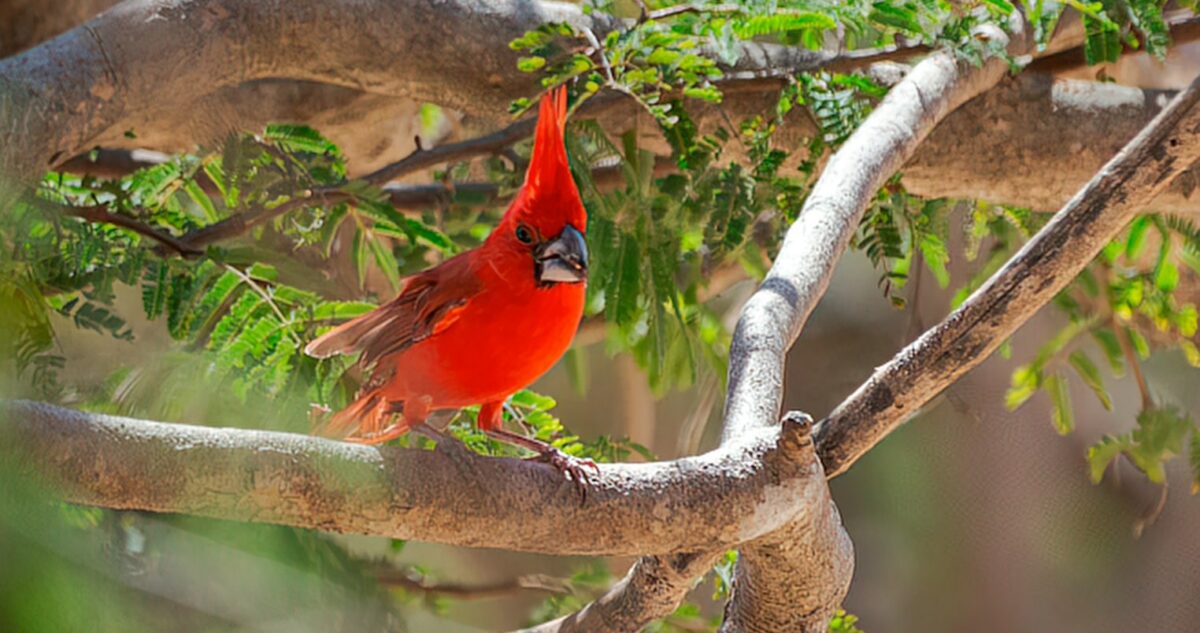
A garish scarlet bird sporting a dramatic spiky crest and a hefty gray bill. Male overall brilliant red with black chin; female brown, gray-headed, with red crest and tail. Often found in pairs, perched in erect posture on the top of bushes or on exposed branches. Common in desert scrub and dry forests in the lowlands. Voice a melodious and slow whistled series.
Habitats e distribuição
The Vermilion Cardinal inhabits dry, scrubby environments typically found in lowland and arid regions. It can be commonly found in thorn forests, open woodlands, and areas with sparse vegetation, often near water sources. These habitats provide the cover and resources necessary for feeding and nesting. Geographically, the Vermilion Cardinal is distributed across northern Colombia and Venezuela, with its range extending into eastern Panama. This bird tends to favor altitudes from sea level up to around 500 meters, although it is sometimes found at higher elevations. Its vibrant red plumage and distinctive song make it a noticeable presence in these areas.
Comportamentos e reprodução
The Vermilion Cardinal typically exhibits monogamous mating habits, forming strong pair bonds that often last for multiple breeding seasons. During courtship, males engage in vivid displays of their striking red plumage and sing complex songs to attract a mate. These displays are not only intended to woo the female but also to establish and defend territory from rival males. Once paired, the female primarily assumes responsibility for nest building, using twigs, grass, and other plant materials to construct a well-hidden nest in dense foliage. In terms of social structure, the Vermilion Cardinal tends to be territorial, especially during the breeding season, with both sexes defending their nesting site. The female lays a clutch of two to four pale blue eggs, which she incubates for about 12 to 13 days. After hatching, both parents share the duties of feeding and protecting the chicks, which fledge approximately 10 days after hatching. The cooperative involvement of both parents in rearing the young underscores their strong pair bond and enhances the survival rate of their offspring.
Dieta
Sementes, frutos e insectos.
Cores
Vermelho
Factos divertidos
Unmistakable in arid regions of northern Venezuela and extreme northeastern Colombia.
Estado de conservação e esforços
The Vermilion Cardinal is currently classified as Least Concern by the IUCN Red List, indicating that it is not at immediate risk of extinction. However, its population trend is believed to be declining, primarily due to habitat loss and degradation. Deforestation for agricultural development and urban expansion are the major threats to its natural habitats in Colombia and Venezuela. Additionally, the illegal pet trade poses a significant risk to its populations. Conservation efforts focus on habitat preservation and legal protection. Several organizations work to conserve critical habitats and promote sustainable land-use practices in the regions where the species is found. Regulatory measures are being enforced to curb the illegal pet trade, including stricter monitoring and penalties for wildlife trafficking. Collaboration with local communities is also emphasized to foster awareness and support for the conservation of the Vermilion Cardinal.




